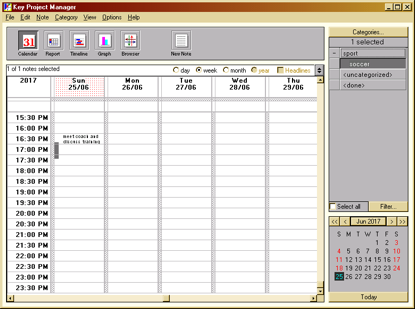
It took me a little while to get the idea of this straight. Having been familiar with Primavera scheduling packages, this was a new approach.
These days we'd call it a task manager, and at that it seems to touch a point that is omitted by the very popular task manager category today: tasks have durations. We estimate these, then can give 'actuals'. Tracking both against a type category system would allow one to calibrate one's performance at estimating and get better at it.
It also fails to link tasks in a dependency relationship. I wouldn't want anything like P6 here, but to keep track of the mountain of tasks in a live work system (with serious volume) it is essential. Linking to document would also be important.
Those crits made, I like the interface and concept, although, naturally it is nowhere near as elegant or cross-platform/cloud useful like my current tool Pagico.
My experiences, observations and thoughts about the computers I use and what they do for me.
Wednesday, August 23, 2017
Sunday, August 20, 2017
AskSam
This seems to have a single window interface, and relies on its search capability to find entries. It has a type of card file metaphor, but far less useful than Zoot, for example.
Labels:
Old Computing,
PIMs
Wednesday, August 16, 2017
RFF
RF Flow: a flow charting package that just dipped its toe into the Windows world. I used it quite a lot for work process maps.
Labels:
Old Computing
Sunday, August 13, 2017
Zephyr
Another of Ward Mundy's great database packages. This was menu driven and could build applications from the menu.
I've only got a demo version...must write to Ward for an unlock so I can further experiment.
Labels:
Old Computing
Monday, August 7, 2017
InfoSelect
This had to be my favourite package in the late 80s early 90s. It ran as a 'TSR', terminate and stay resident application, so it could be 'popped up' over a foreground program for intermittent use. I've mentioned it before, but here are some screen shots. Note the quirky menu item names.
Labels:
Old Computing,
PIMs
Wednesday, August 2, 2017
DataPerfect
An innovative RDMS from WordPerfect. It started life as a data management system for legal practices, I understand.
It has some quite nice ideas.
Labels:
Old Computing
Sunday, July 30, 2017
Wampum
One of the great shareware databases produced by Ward Mundy (who I recently exhanged e-mails with...I must ask for unlock keys for Wampum so I can play with it a little more).
Labels:
Old Computing
Wednesday, July 26, 2017
Surefire
Before MS Word had classy things like fields, an obscure shareware package had them. It may have been inspired by Q&A, an 80s data management-word processor.
Some screens from Surefire:
Labels:
Old Computing
Sunday, July 23, 2017
ZoomRacks
My first piece of non-linear PIM software. ZoomRacks. It came from Atari, I think, and was designed with a card file metaphor in a text-based system. So nothing looked like a card. It has some hypertext functionality. So here we are, from the mid 1980s.
Labels:
Old Computing,
PIMs
Wednesday, July 19, 2017
My Assistant
I was IT manager for a large consulting firm in the late 1980s and after implementing a production IT system, was looking around for a local user organising tool. This was before the days of MS Outlook, or other more sophisticated PIMs that brought notes, diary and do-lists together.
My Assistant was reviewed in a newspaper article; the developer was in North Sydney, near my office, so I dropped in to visit. He demonstrated the software, which he had developed for a politician friend of his.
It looked great, but the board of my company was less impressed, being keen pen and paper users.
Here's a screen from it.
My Assistant was reviewed in a newspaper article; the developer was in North Sydney, near my office, so I dropped in to visit. He demonstrated the software, which he had developed for a politician friend of his.
It looked great, but the board of my company was less impressed, being keen pen and paper users.
Here's a screen from it.
Labels:
Old Computing,
PIMs
Subscribe to:
Posts (Atom)